| 1st Semester (BS Cyber Security Technology) | ||||
| Description | Frequency | Fee/Cr. Hr | # of Cr. Hr | Total Fee |
| Admission Fee | One-Time | 10,000 | 10,000 | |
| Security Deposit (Refundable) | One-Time | Nil | Nil | |
| Tuition Fee | Per Month | 9,150 | ||
| Examination Fee | Per Month | 850 | ||
| Student Activiity Fee | Per Semester | Nil | Nil | |
| Registration Fee | Per Semester | Nil | Nil | |
| Total Fees | 10,000 | |||
| Per Month | 10,000 | |||
BS Cyber Security Technology

- Introduction
- Eligibility Criteria
- Study Scheme
- Career Prospects
- Learning Outcomes
- Fee Structure
Ziauddin University’s BS Cybersecurity degree programme equips students with the specialised knowledge and practical skills needed to protect digital systems, networks, and data from evolving cyber threats, preparing them for impactful careers in one of today’s most critical and fast-growing fields.
Vision
To be a leading hub of innovation and excellence in computing—shaping future-ready professionals, pioneering research, and transformative solutions in the ever-evolving world of technology.
Mission
Our mission is to produce competent graduates with a strong foundation in cybersecurity principles and practical expertise in protecting, securing, and managing digital systems, networks, and data. We aim to bridge the gap between academic knowledge and industry practices by nurturing problem-solving abilities, innovation, and a proactive approach to identifying and mitigating cybersecurity threats. Alongside technical excellence, we emphasise the development of effective communication skills, ethical responsibility, teamwork, and a commitment to lifelong learning—empowering our students to strengthen cyber defences, drive technological security advancements, and contribute meaningfully to the cybersecurity industry and society.
Programme Educational Objectives (PEO)
PEO 1: Graduates will be effective cybersecurity practitioners with the ability to assess and manage security risks, implement protective measures, and respond to security incidents in a variety of computing environments.
PEO 2: Graduates will demonstrate proficiency in identifying and solving complex cybersecurity challenges, adapting to emerging threats, and contributing to innovative security solutions within the rapidly evolving field of cybersecurity.
PEO 3: Graduates will excel in both written and oral communication, as well as teamwork, enabling them to convey technical information clearly, work effectively in interdisciplinary teams, and engage with diverse stakeholders.
PEO 4: Graduates will uphold the highest ethical standards in cybersecurity practice, considering the ethical, legal, and social implications of their work, and demonstrating a commitment to responsible and socially responsible cybersecurity.
Lab Facilities
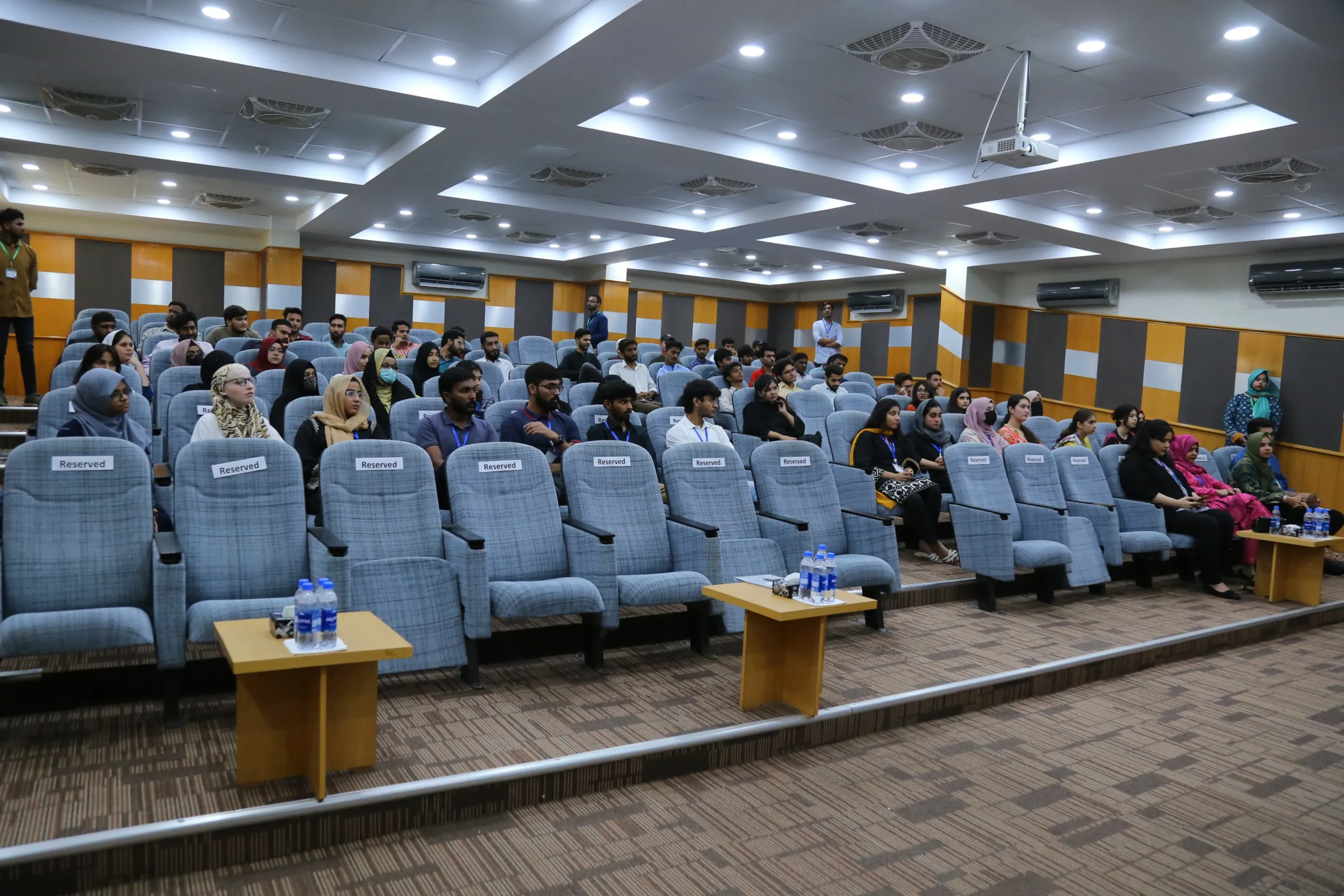
Lecture Rooms & Instructional Facilities
- Room Type: Dedicated and Shared Lecture Rooms
- Lecture Room Size: Each room is approximately 350 square feet in size.
- Available Space per Student: 30 square feet per student.
- Instructional Equipment: Each lecture room is equipped with a whiteboard, multimedia projectors, speaker system, computers, and internet connectivity.
Additional Amenities: The rooms are fully air-conditioned for a comfortable learning environment.
Laboratories
Lab Name | Timings | Facilities | Lab Space per Student |
|---|---|---|---|
Computing Lab | Weekdays (8:30am–4:30pm) | 32 Workstations (Core i3/i5, 3rd & 6th Gen), High-end Software, LAN/Wi-Fi, Scanner, Printing, Whiteboard, Multimedia | 40 sq. ft |
Operating System Lab | Weekdays (8:30am–4:30pm) | 5 Workstations (Core i3/i5, 3rd & 6th Gen), High-end Software, LAN/Wi-Fi, Printing Facility | 40 sq. ft |
Final Year Project Lab | Weekdays (8:30am–4:30pm) | 3 Workstations (Core i3/i5, 3rd & 6th Gen), High-end Software, LAN/Wi-Fi, Printing, Sensors, Potentiometer, 22″ LCD with HDMI, Extension Board | Not specified |
Why Choose BS Cybersecurity
Ziauddin University’s BS Cybersecurity programme prepares students to become skilled professionals capable of defending digital systems and data in today’s interconnected world. This programme offers a balanced mix of theoretical foundations and practical experience, empowering graduates to address real-world cybersecurity challenges across industries.
- Comprehensive core curriculum: The Cybersecurity programme offers a well-structured curriculum covering key areas such as network security, ethical hacking, cryptography, digital forensics, risk management, and secure software development. The curriculum is aligned with global academic standards and the latest industry requirements.
- Strong technical foundation: Students gain hands-on experience with security tools, penetration testing techniques, and secure coding practices, enabling them to detect, prevent, and respond to cyberattacks effectively.
- Emphasis on problem-solving and critical thinking: The programme enhances students’ analytical abilities and decision-making skills, crucial for assessing vulnerabilities, managing security incidents, and developing proactive defence strategies.
- Exposure to emerging technologies: Students are introduced to cutting-edge topics such as cloud security, IoT security, blockchain, and artificial intelligence applications in cybersecurity, giving them a competitive advantage in the digital security landscape.
- Project-based learning and industry alignment: Through capstone projects, internships, and collaboration with industry experts, students apply theoretical concepts to real-world security challenges, preparing them for professional roles in government, corporate, and nonprofit sectors.
Communication and teamwork skills: The programme emphasises the development of soft skills, such as effective communication, ethical responsibility, teamwork, and leadership, essential for success in multidisciplinary cybersecurity teams.
Location & Infrastructure
Campus Location: North Site (ZUFESTM), F-103, Block B, North Nazimabad, Karachi.
Covered Area: The ZUFESTM area spans 18,000 square feet (approximately 2,000 square yards), while the SE Department occupies 180 square feet.
Building Ownership: The facilities are located in a university-owned building.
At least 50% marks in Intermediate (HSSC) examination with Mathematics or equivalent qualification with Mathematics, certified by IBCC. OR At least 50% marks in Intermediate (HSSC) examination with a pre-medical or equivalent qualification, certified by IBCC.
Deficiency: Students with pre-medical must have to pass deficiency courses of Mathematics of 06 credit hours in first two semesters.
Programme Type
Semester system
Semester Duration
Semester System:
- 16 weeks of Teaching
- 2 weeks for Exams
Programme Duration/Length
- 8 Semesters
- Min: 4 Years
- Max: 7 Years
Weightage for the final examination
- Attendance* 10%
- Continuous assessments 40%
- Final Examination 50%
Semester 1st
| SEMESTER I | ||||||
| S. No. | Course Code | Course Title | Th. | Lab | Cr. Hr. | Pre-requisite |
| 1 | CS-107T | Introduction to Info. & Comm. Technologies (Theory) (Computing-I) | 1 | 0 | 1+2 | |
| 2 | CS-107L | Introduction to Info. & Comm. Technologies (Lab) (Computing-I) | 0 | 2 | ||
| 2 | CS-104T | Programming Fundamentals (Theory) (Computing-II) | 2 | 0 | 2+2 | |
| 3 | CS-104L | Programming Fundamentals (Lab) (Computing-II) | 0 | 2 | ||
| 4 | NS-109 | Calculus And Analytical Geometry (Natural Sciences-I) | 3 | 0 | 3+0 | |
| 5 | NS-106T | Applied Physics (Theory) (Natural Sciences-II) | 2 | 0 | 2+1 | |
| 6 | NS-106L | Applied Physics (Lab) (Natural Sciences-II) | 0 | 1 | ||
| 7 | HS-100 | English Composition & Comprehension (Humanities and Social Sciences-I) | 2 | 0 | 2+0 | |
| 8 | HS-101 | Islamic Studies/Ethical Behaviour (Humanities and Social Sciences-II) | 2 | 0 | 2+0 | |
| HS-102 | ||||||
| Total | 12 | 5 | 17 | |||
Semester 2nd
| SEMESTER II | ||||||
| S. No. | Course Code | Course Title | Th. | Lab | Cr. Hr. | Pre-requisite |
| 1 | CS-112T | Object Oriented Programming (Theory) | 2 | 0 | 2+2 | Programming Fundamentals (Theory and Lab) |
| (Cyber Security) Foundation-I | ||||||
| 1 | CS-112L | Object Oriented Programming (Lab) | 0 | 2 | ||
| (Cyber Security) Foundation-I | ||||||
| 2 | EE-100T | Digital Logic Design (Theory) | 2 | 0 | 2+1 | |
| (Cyber Security) Foundation-II | ||||||
| 3 | EE-100L | Digital Logic Design (Lab) | 0 | 1 | ||
| (Cyber Security) Foundation-II | ||||||
| 4 | HS-103 | Pakistan Studies | 2 | 0 | 2+0 | |
| (Humanities and Social Sciences-III) | ||||||
| 5 | HS-114 | Communication and Presentation Skills | 3 | 0 | 3+0 | English Composition & Comprehension |
| (Humanities and Social Sciences-IV) | ||||||
| 6 | NS-110 | Linear Algebra (Natural Sciences-III) | 2 | 0 | 2+0 | Calculus and Analytical Geometry |
| 7 | CS-102T | Web Engineering (Theory) | 1 | 0 | 1+2 | |
| (Cyber Security) Foundation-III | ||||||
| 8 | CS-102L | Web Engineering (Lab) | 0 | 2 | ||
| (Cyber Security) Foundation-III | ||||||
| Total | 12 | 5 | 17 | |||
Semester 3rd
| SEMESTER III | ||||||
| S. No. | Course Code | Course Title | Th. | Lab | Cr. Hr. | Pre-requisite |
| 1 | CS-211T | Data Structures and Algorithms (Theory) | 2 | 0 | 2+1 | Programming Fundamentals (Theory and Lab) |
| (Cyber Security) Foundation-IV | ||||||
| 2 | CS-211L | Data Structures and Algorithms (Lab) | 0 | 1 | ||
| (Cyber Security) Foundation-IV | ||||||
| 3 | CS-203T | Computer Communication Networks (Theory) | 2 | 0 | 2+2 | |
| (Cyber Security) Foundation-V | ||||||
| 4 | CS-203L | Computer Communication Networks (Lab) | 0 | 2 | ||
| (Cyber Security) Foundation-V | ||||||
| 5 | HS-231 | Technical and Business Writing (Humanities and Social Sciences-V) | 2 | 0 | 2+0 | Communication & Presentation Skills |
| 6 | CB-231T | Introduction to Cyber Security (Theory) | 2 | 0 | 2+1 | |
| (Cyber Security) Breadth-II | ||||||
| 7 | CB-231L | Introduction to Cyber Security (Lab) (Cyber Security) Breadth-II | 0 | 1 | ||
| 8 | NS-206 | Probability and Statistics | 3 | 0 | 3+0 | |
| (Natural Sciences-IV) | ||||||
| 9 | CS-213T | Introduction to Database System (Theory) | 2 | 0 | 2+1 | Data Structures & Algorithms (Theory and Lab) |
| (Cyber Security) Foundation-V | ||||||
| 10 | CS-213L | Introduction to Database System (Lab) (Cyber Security) Foundation-V | 0 | 1 | ||
| Total | 13 | 5 | 18 | |||
Semester 4th
| SEMESTER IV | ||||||
| S. No. | Course Code | Course Title | Th. | Lab | Cr. Hr. | Pre-requisite |
| 1 | CS-234T | Operating Systems (Theory) | 2 | 0 | 2+1 | Data Structures & Algorithms (Theory and Lab) |
| (Cyber Security) Breadth -III | ||||||
| 2 | CS-234L | Operating Systems (Lab) | 0 | 1 | ||
| (Cyber Security) Breadth -III | ||||||
| 3 | CS-214T | Computer Organization & Assembly Language (Theory) | 2 | 0 | 2+1 | Digital Logic Design (Theory and Lab) |
| 4 | CS-214L | Computer Organisation & Assembly Language (Lab) | 0 | 1 | ||
| 5 | CS-235T | Artificial Intelligence (Theory) | 1 | 0 | 1+1 | Object Oriented Programming (Theory and Lab) |
| (Cyber Security) Breadth -V | ||||||
| 6 | CS-235L | Artificial Intelligence (Lab) | 0 | 1 | ||
| (Cyber Security) Breadth -V | ||||||
| 7 | CB-232T | Systems And Network Administration (Theory) | 1 | 0 | 1+2 | Computer Communication Networks (Theory & Lab) |
| (Cyber Security) Breadth -IV | ||||||
| 8 | CB-232L | Systems And Network Administration (Lab) | 0 | 2 | ||
| (Cyber Security) Breadth -IV | ||||||
| 9 | CS-215T | Information Security (Theory) | 2 | 0 | 2+1 | Computer Communication Networks (Theory & Lab) |
| (Cyber Security) Foundation-VI | ||||||
| 10 | CS-215L | Information Security (Lab) | 0 | 1 | ||
| (Cyber Security) Foundation-VI | ||||||
| 11 | HS-207 | Psychology (University Elective-1) | 3 | 0 | 3+0 | |
| Total | 11 | 6 | 17 | |||
Semester 5th
| SEMESTER V | ||||||
| S. No. | Course Code | Course Title | Th. | Lab | Cr. Hr. | Pre-requisite |
| 1 | MS-303 | Human Resource Management (University Elective-II) | 3 | 0 | 3+0 | |
| 2 | CS-355T | Machine Learning (Theory) | 1 | 0 | 2+1 | Artificial Intelligence (Theory & Lab) |
| (Depth Elective-1) | ||||||
| 3 | CS-355L | Machine Learning (Lab) | 0 | 2 | ||
| (Depth Elective-1) | ||||||
| 4 | CS-351T | Block Chain Technology and Application (Theory) | 2 | 0 | 2+2 | |
| (Depth Elective-II) | ||||||
| 5 | CS-351L | Block Chain Technology and Application (Lab) | 0 | 2 | ||
| (Depth Elective-II) | ||||||
| 6 | HS-304 | Professional Practices | 2 | 0 | 2+0 | |
| (Humanities and Social Sciences-VI) | ||||||
| 7 | MS-304 | Entrepreneurship and Leadership (Management Elective-1) | 3 | 0 | 3+0 | |
| Total | 11 | 4 | 15 | |||
Semester 6th
| SEMESTER VI | ||||||
| S. No. | Course Code | Course Title | Th. | Lab | Cr. Hr. | Pre-requisite |
| 1 | CB-361 | Final Year Project-I | 0 | 3 | 0+3 | |
| 2 | MS-300 | Information Technology Project Management (Management Elective-II) | 2 | 0 | 2+0 | |
| 3 | CB-352T | Error Correction and Coding Techniques (Theory) | 1 | 0 | 1+1 | Object Oriented Programming (Theory and Lab) |
| (Depth Elective-III) | ||||||
| 4 | CB-352L | Error Correction and Coding Techniques (Lab) | 0 | 1 | ||
| (Depth Elective-III) | ||||||
| 5 | CB-331T | Incident Response and Digital Forensics (Theory) | 2 | 0 | 2+1 | Information Security (Theory & Lab) |
| (Information Security) Breadth -VI | ||||||
| 6 | CB-331L | Incident Response and Digital Forensics (Lab) | 0 | 1 | ||
| (Information Security) Breadth -VI | ||||||
| 7 | CB-353T | IT Security Audit and Evaluation (Lab) (Cyber Security) Depth –IV | 2 | 0 | 2+1 | Information Security (Theory & Lab) |
| 8 | CB-353L | IT Security Audit and Evaluation (Lab) (Cyber Security) Depth –IV | 0 | 1 | ||
| 9 | BM-300T | Bioinformatics (Theory) (IDTE-I) | 1 | 0 | 1+1 | |
| 10 | BM-300L | Bioinformatics (Lab) (IDTE-I) | 0 | 1 | ||
| Total | 8 | 7 | 15 | |||
Semester 7th
| SEMESTER VII | ||||||
| S. No. | Course Code | Course Title | Th. | Lab | Cr. Hr. | Pre-requisite |
| 1 | CB-462 | Final Year Project-II | 0 | 3 | 0+3 | |
| 2 | NS-401 | Health, Safety and the Environment | 1 | 0 | 1+0 | |
| (Humanities and Social Sciences-VII) | ||||||
| 3 | CB-451T | Cryptography (Theory) | 2 | 0 | 2+1 | |
| (Depth Elective-IV) | ||||||
| 4 | CB-451L | Cryptography (Lab) | 0 | 1 | ||
| (Depth Elective-IV) | ||||||
| 5 | CB-452T | Cloud Computing and IoT (Theory) | 2 | 0 | 2+1 | |
| (Depth Elective-V) | ||||||
| 6 | CB-452L | Cloud Computing and IoT (Lab) | 0 | 1 | ||
| (Depth Elective-V) | ||||||
| 7 | CB-457T | Ethical Hacking and Penetration Testing (Theory) | 2 | 0 | 2+1 | Information Security (Theory & Lab) |
| (Cyber Security Depth – VII) | ||||||
| 8 | CB-457L | Ethical Hacking and Penetration Testing (Lab) | 0 | 1 | ||
| (Cyber Security Depth – VII) | ||||||
| 9 | EE-464 | Renewable Energy (IDTE-II) | 2 | 0 | 2+0 | |
| Total | 9 | 6 | 15 | |||
Semester 8th
| SEMESTER VIII | ||||||
| S. No. | Course Code | Course Title | Th. | Lab | Cr. Hr. | Pre-requisite |
| 1 | CB-464 | Supervise Industrial Training (Compulsory) | 0 | 16 | 0+16 | |
| Total | 0 | 16 | 16 | |||
Total Credit Hours = 130
Total Lab Credit Hours=54 (41.54)
Total Theory Credit Hours = 76 (58.46)
Cybersecurity is a rapidly growing field with critical importance across all industries, offering diverse and rewarding career opportunities. Below are some popular career paths for Cybersecurity graduates:
Cybersecurity Analyst
Cybersecurity analysts are responsible for monitoring and protecting an organisation’s IT systems and networks. They detect, investigate, and respond to security incidents, conduct vulnerability assessments, and recommend improvements to prevent cyberattacks.
Penetration Tester (Ethical Hacker)
Penetration testers simulate cyberattacks on systems, networks, and applications to identify vulnerabilities before malicious hackers can exploit them. They use tools like Metasploit, Burp Suite, and Kali Linux to test defences and provide actionable recommendations.
Security Engineer
Security engineers design and implement secure systems, networks, and applications. They focus on creating robust architectures, deploying firewalls and intrusion detection systems, and automating security measures to protect digital assets.
Incident Response Specialist
Incident response specialists lead efforts to investigate and recover from security breaches or cyberattacks. They identify the cause of incidents, contain threats, restore systems, and develop lessons learnt to strengthen future defences.
Network Security Engineer
Network security engineers protect the integrity of network infrastructure by implementing firewalls, VPNs, intrusion prevention systems, and other security controls. They ensure data is securely transmitted across internal and external networks.
Cloud Security Specialist
Cloud security specialists focus on securing cloud environments such as AWS, Azure, and Google Cloud. They develop and apply security policies, manage access controls, and ensure data confidentiality, integrity, and availability in the cloud.
Digital Forensics Analyst
Digital forensics analysts investigate cybercrimes by recovering and analysing data from computers, mobile devices, and networks. They collect evidence to support legal investigations and help organisations understand and respond to security incidents.
Application Security Engineer
Application security engineers embed security into the software development lifecycle. They review code, perform static and dynamic testing, and work with development teams to fix vulnerabilities and improve software resilience.
Security Architect
Security architects design an organisation’s overall security strategy and architecture. They create frameworks, establish policies, and select technologies to protect systems, data, and users against evolving cyber threats.
Governance, Risk, and Compliance (GRC) Specialist
GRC specialists help organisations align cybersecurity practices with regulatory requirements and business objectives. They perform risk assessments, develop compliance programmes, and ensure adherence to standards like ISO 27001, NIST, and GDPR.
Chief Information Security Officer (CISO)
CISOs lead the organisation’s cybersecurity strategy at the executive level. They oversee teams, manage risk, set security policies, and communicate with senior leadership to align cybersecurity initiatives with business goals.
Identity and Access Management (IAM) Specialist
IAM specialists manage user identities, authentication systems, and access permissions across an organisation’s IT environment. They ensure that only authorised users can access sensitive data and systems.
Security Operations Center (SOC) Analyst
SOC analysts monitor real-time security alerts, triage incidents, and respond to potential threats from within a centralised security operations centre. They are the first line of defence against active cyberattacks.
Threat Intelligence Analyst
Threat intelligence analysts gather, analyse, and interpret data on emerging cyber threats. They provide organisations with actionable insights to anticipate and defend against potential attacks.
Malware Analyst / Reverse Engineer
Malware analysts dissect malicious software to understand how it works, identify its indicators of compromise (IOCs), and develop defences or removal strategies. They often work closely with incident response and forensic teams.
PLO 1: Engineering Technology Knowledge: An ability to apply knowledge of mathematics, natural science, Engineering Technology fundamentals, and Engineering Technology specialisation to defined and applied Engineering Technology procedures, processes, systems, or methodologies.
PLO 2: Problem Analysis: An ability to Identify, formulate, research literature, and analyse broadly defined Engineering Technology problems reaching substantiated conclusions using analytical tools appropriate to the discipline or area of specialisation.
PLO 3: Design/Development of Solutions: An ability to design solutions for broadly defined Engineering Technology problems and contribute to the design of systems, components or processes to meet specified needs with appropriate consideration for public health and safety, cultural, societal, and environmental considerations.
PLO 4: Investigation: An ability to conduct investigations of broadly defined problems; locate, search and select relevant data from codes, databases, and literature; and design and conduct experiments to provide valid conclusions.
PLO 5: Modern Tool Usage: An ability to Select and apply appropriate techniques, resources, and modern technology and IT tools, including prediction and modelling, to broadly defined Engineering Technology problems, with an understanding of the limitations.
PLO 6: The Engineering Technologist and Society: An ability to demonstrate understanding of the societal, health, safety, legal and cultural issues and the consequent responsibilities relevant to Engineering Technology practice and solutions to broadly defined Engineering Technology problems.
PLO 7: Environment and Sustainability: An ability to understand and evaluate the sustainability and impact of Engineering Technology work in the solution of broadly defined Engineering Technology problems in societal and environmental contexts.
PLO 8: Ethics: Understand and commit to professional ethics and responsibilities, and norms of Engineering Technology practice.
PLO 9: Individual and Teamwork: An ability to function effectively as an individual and as a member or leader in diverse teams.
PLO 10: Communication: An ability to communicate effectively on broadly defined Engineering Technology activities with the Engineering Technologist community and with society at large by being able to comprehend and write effective reports and design documentation, make effective presentations, and give and receive clear instructions.
PLO 11: Project Management: An ability to demonstrate knowledge and understanding of Engineering Technology management principles and apply these to one’s work as a member or leader in a team and to manage projects in multidisciplinary environments.
PLO 12: Lifelong Learning: An ability to recognise the need for and have the ability to engage in independent and lifelong learning in specialist Engineering Technologies.